




EBC Latest Report

As some organisations approach the end of their financial year while others begin a new chapter, I recognise that this is not the first time I have written about the interplay between HR and Finance. However, in today’s climate marked by ongoing geopolitical uncertainty, tighter cost controls, and an unrelenting need for high-quality talent, the partnership between these two functions has never been more critical. Organisations are being challenged to do more with less, while simultaneously building capabilities for the future. This creates a natural tension: cost discipline vs. talent investment. Finance drives accountability, efficiency, and return on investment. HR ensures the organisation has the capability, agility, and leadership to deliver on those expectations. The reality is that transformation today sits squarely at the intersection of both. Without financial discipline, transformation lacks sustainability. Without the right talent, it fails in execution Most transformation failures are not due to flawed strategy, but poor execution, whereby common breakdowns include: Misaligned leadership priorities Cultural resistance to change Critical talent gaps From a finance perspective, these show up as cost overruns, delayed ROI, and unrealised value creation. From an HR perspective, they manifest as disengagement, capability gaps, and organisational friction. The takeaway is clear: financial outcomes are deeply tied to people outcomes. Where HR & Finance Jointly Drive Impact Linking Talent Investment to Business Strategy Transformation requires capital, but increasingly, that capital is deployed into talent. Take organisations shifting toward sustainability as an example. This shift requires more than strategic intent, it demands new skill sets, new roles, and a rethinking of workforce priorities. In such cases, HR plays a critical role in realigning talent strategy to support long-term business goals, ensuring the organisation is equipped to execute effectively. From a finance perspective, this is about disciplined capital allocation into high-impact, strategic roles. From an HR perspective, it is about building capabilities and aligning the workforce to evolving business needs. Culture as a Measurable Performance Lever Culture may be difficult to quantify, but its impact on business performance is undeniable. Rigid or low-trust environments often lead to slower decision-making, weaker innovation, reduced productivity, and higher turnover. Organisations who address this by embedding candid, open feedback mechanisms, encourages challenge, experimentation, and faster problem-solving. From a finance perspective, this drives higher productivity and faster innovation cycles. From a HR perspective, it builds psychological safety and stronger employee engagement. The outcome is a culture that accelerates execution and delivers sustained commercial performance. Reskilling as a Capital Allocation Strategy In a constrained hiring market, “build vs. buy” is no longer just a talent question, it has become a capital allocation decision. Organisations that invest strategically in upskilling and reskilling can future-proof their workforce while reducing reliance on external hiring. From a finance lens, this results in improved return on talent investment and lower recruitment costs. From a HR lens, this promotes greater workforce agility, internal mobility and even succession planning. Driving Execution Through Leadership Alignment Even the best strategies can fail without aligned execution across leadership teams. HR plays a critical role in ensuring that leaders are coordinated, priorities are clear, and the organisation is equipped to deliver strategic initiatives effectively. When leadership is aligned, organisations deploy resources more efficiently, accelerate the realisation of financial and strategic goals, and reduce the risk of costly delays or misdirected investments. Clear alignment also ensures that investments in talent, such as reskilling, development, and leadership programs, translate into measurable business outcomes. The result is a cohesive organisation capable of executing complex strategies efficiently, driving sustainable growth, and maximising the return on both capital and human resources. In conclusion, organisations that successfully integrate both Finance and HR perspectives are better positioned to: Deliver transformation on time and within budget Maximise return on talent investments Build resilience in an increasingly uncertain environment In today’s landscape, competitive advantage no longer comes from strategy alone, it comes from the ability to align financial discipline with workforce capability. For organisations navigating transformation, having the right people in place is critical. If you would like to discuss this topic in more detail, explore market insights, or get support in identifying and recruiting the talent your team needs to succeed, feel free to reach out to Jillian Yip , Director, Accounting & Finance.
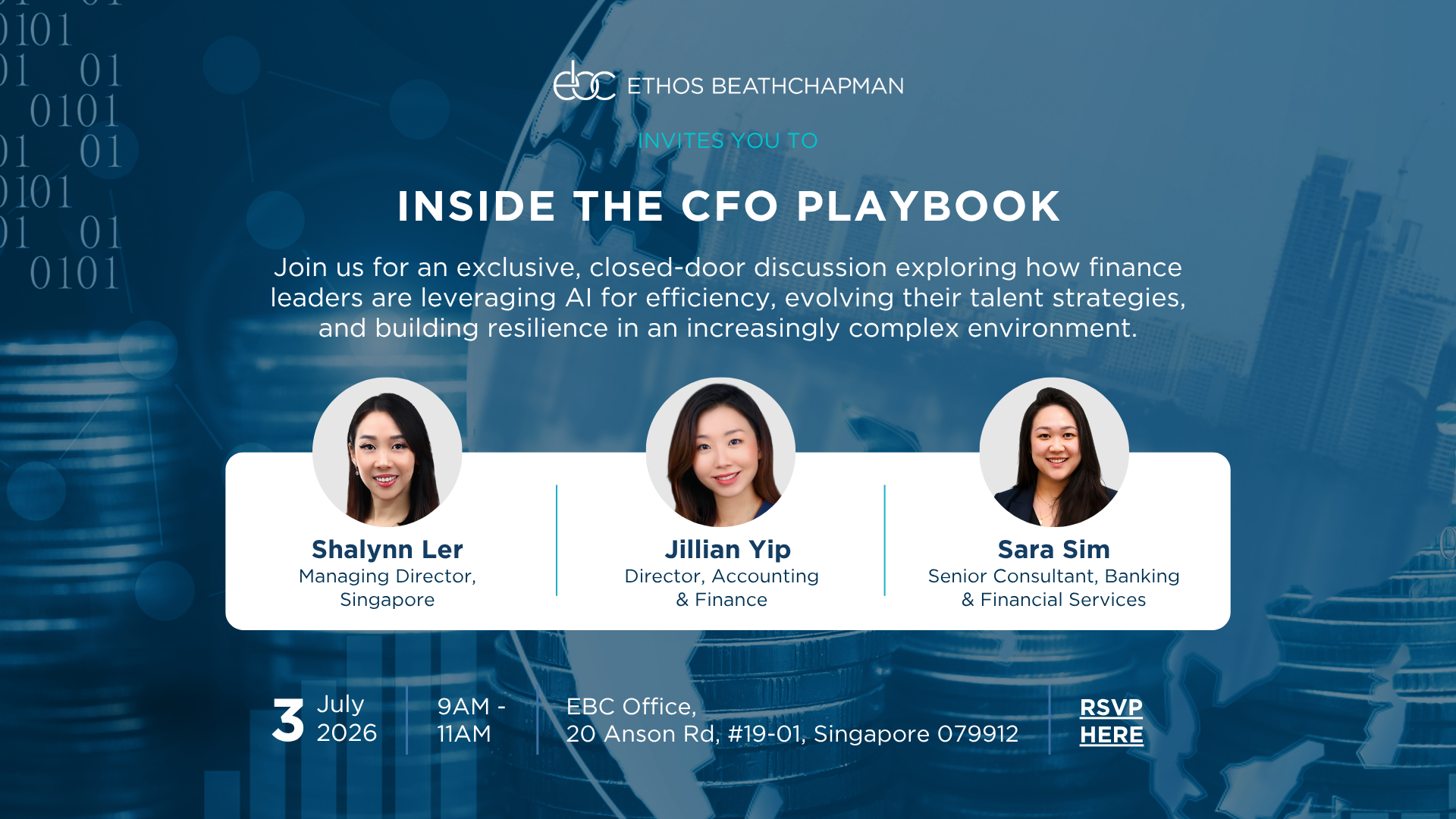
Event Overview Join us for an exclusive, closed-door discussion designed for senior finance leaders navigating today’s rapidly evolving landscape. Led by senior leaders within EBC's Banking & Financial Services team, this intimate session will explore how CFOs are driving efficiency through AI, rethinking talent strategies, and building resilience amid growing complexity. What to Expect A candid, peer-led conversation covering: Practical applications of AI within finance functions Evolving talent needs and workforce strategies Strengthening organisational resilience in uncertain markets Date: Friday, 3 July 2026 Time: 9A M – 11 AM Location: EBC Office, Twenty Anson, #19-01 We look forward to welcoming you to our office for an engaging roundtable discussion with fellow industry leaders. The EBC Team